A build that took two years can be degraded in one summer by a window. The failure modes are well understood and all of them are preventable, but they are slow enough that nobody notices until the damage is done. Four things do the damage: ultraviolet light, humidity, temperature cycling, and mechanical handling.
UV: the one that changes colour
Prolonged UV exposure yellows resin and eventually produces a chalk-like surface dust as the exterior breaks down. Oxygen accelerates the same process, causing surface oxidation that gradually blurs fine detail — the crisp edge on a cast part softens, and no amount of cleaning restores it.
Clear parts suffer worst and most visibly. A clear acrylic dome that yellows cannot be restored; polishing removes the damaged surface layer at the cost of optical flatness, and the yellowing runs deeper than a polish reaches.
What works:
- Keep it away from windows. Direct sun is obvious; indirect daylight through a north-facing window still carries UV.
- Watch the artificial light too. Fluorescent tubes emit UV. Use cool, low-heat, UV-free LED lighting for display cases and workshops.
- Seal the surface. A UV-blocking clear coat before long-term storage is the single highest-return step, and it protects against oxidation as well as light.
- UV-filtering acrylic for display cases, not plain glazing.
Humidity: the one that warps and softens
Some resin formulations take up moisture, which softens the material and swells it unevenly — a slow distortion that shows first as parts no longer fitting where they used to. High humidity also corrodes any internal hardware and eventually reaches electronics.
The target range collectors and conservators converge on is 35–55% relative humidity at roughly 65–72°F (18–22°C). Display cases land at the tighter 40–50%.
A cheap hygrometer in the storage space is worth more than any product you can buy. Once you know the actual number, the fix follows: silica gel in a sealed case for a damp environment, a small humidifier for a heated house in winter that runs too dry, a dehumidifier for a basement.
Temperature cycling: the one that cracks
Steady warmth is survivable. Repeated swings are what cause damage — each cycle flexes materials with different expansion rates against each other, and the stress accumulates at joints and bonded seams until micro-cracking and delamination appear.
This is why garages, attics and unconditioned storage units are the worst places to keep a finished build, even though they are where the space is. A garage in most climates swings 40°F or more between a summer afternoon and a winter night, several hundred times over a few years.
A normal climate-controlled room is what you want. If storage must be in an outbuilding, insulating and conditioning a small closet inside it beats leaving the piece exposed to the full swing.
Handling and support: the one you cause yourself
Large pieces deform under their own weight if supported at the wrong points. A shell resting for years on an edge it was never designed to bear develops a flat spot or a stress crack at that edge.
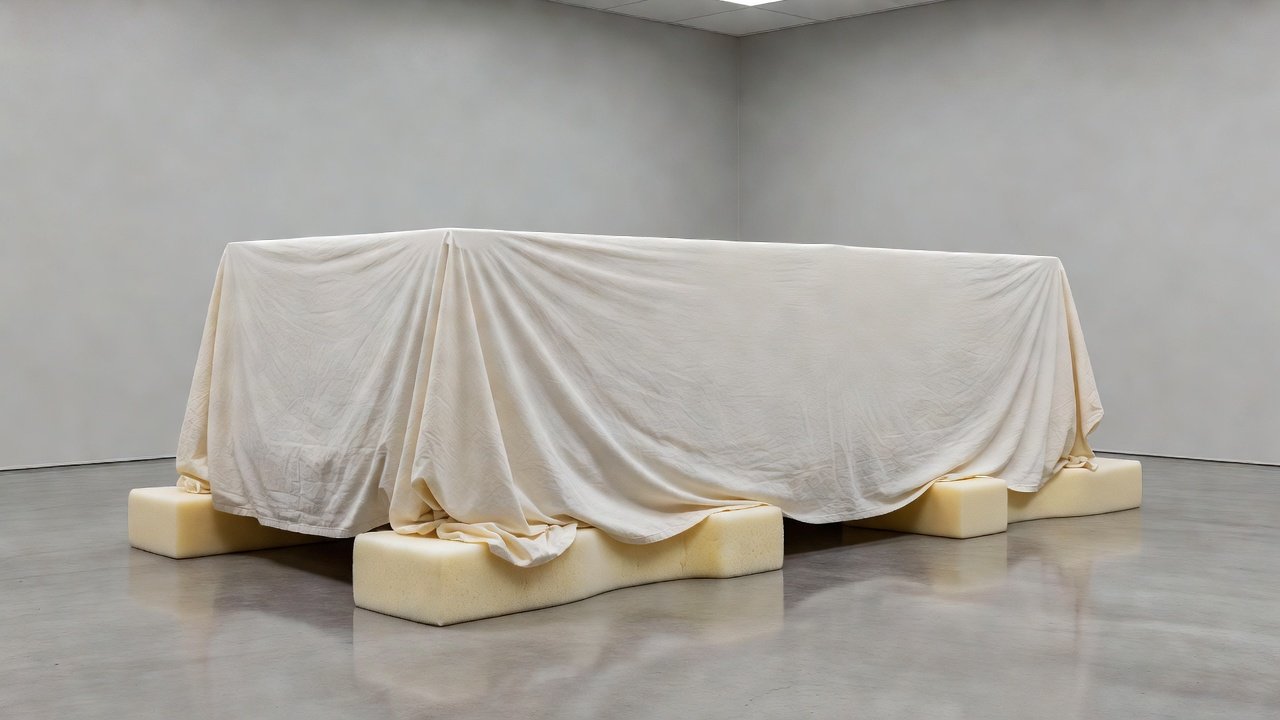
Support large parts the way they were designed to stand, or cradle them on foam that spreads the load. Keep the storage off the floor — floods, pests and vacuum cleaners all live there. Use acid-free materials against painted surfaces; ordinary cardboard and some foams outgas and can mark paint over time.
Vibration matters more than people expect for shelf storage. A piece on a shelf against a wall shared with a workshop, a washing machine or a garage door migrates over months, and eventually migrates off.
A practical storage specification
For a large finished piece going into storage rather than display:
- Clean it first. Dust is hygroscopic and holds moisture against the surface.
- Clear-coat exposed resin and paint with a UV-blocking finish.
- Remove batteries. Always, without exception.
- Wrap in acid-free tissue or unbleached cotton cloth — not plastic sheeting, which traps moisture.
- Support on foam cradles at designed bearing points, off the floor.
- Keep it in conditioned space at 35–55% RH, away from windows and fluorescent light.
- Put a hygrometer in the space and look at it occasionally.
- Inspect annually — earlier if anything in the space changed.
For display rather than storage
The same logic with one addition: sealed cases keep dust off but also keep humidity in, so a case in a damp room needs desiccant inside it. Case lighting should be low-heat LED, mounted so it does not warm the interior, and ideally on a timer rather than running continuously.
None of this is expensive relative to the build. A hygrometer, a can of UV clear coat, some acid-free tissue and a sheet of foam cost less than a weekend of materials — and they are the difference between a piece that looks the same in fifteen years and one that quietly yellows, warps and cracks while sitting still.