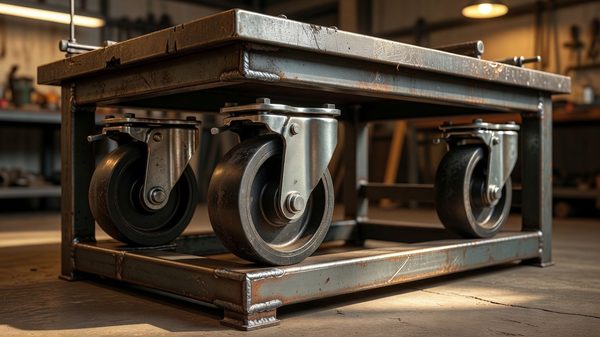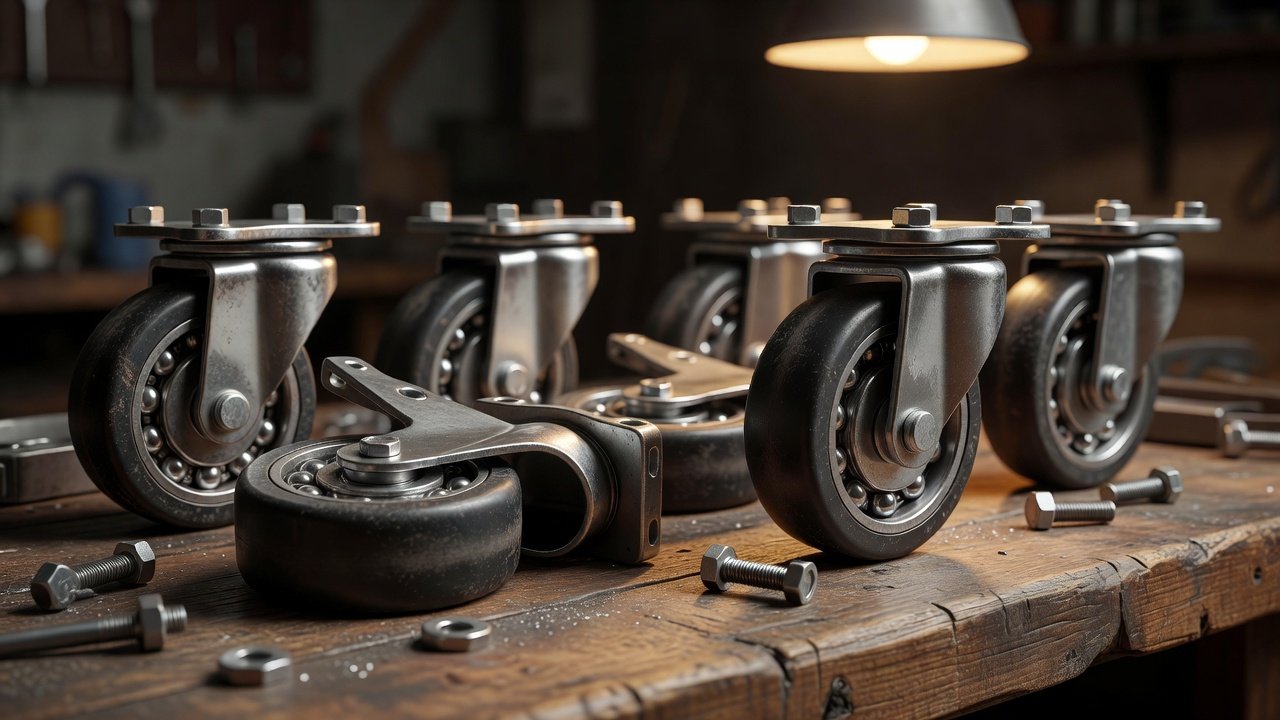
The tread base is the foundation of any B9 replica — everything else stacks on top of it, which means the wheel and caster assembly needs to be right before you move further up the build. Get it wrong and you’ll either have a robot that won’t roll cleanly or one that tips under its own weight when you try to reposition it. This guide covers what the original tread section uses, practical sourcing options for the caster hardware, and the common mounting configurations replica builders have landed on.
What the Original Tread Base Actually Used
The original B9 prop used a wheeled platform that allowed cast and crew to push the costume around the studio floor. Production records and reference photography show a set of rubber-tired wheels arranged around the perimeter of the tread section — not functional treads that actually moved, but a static skirt of tread-shaped elements concealing a rolling base underneath.
For replica builders working from reference photography and the B9 Robot Builders Club documentation, a full wheel set is typically described as 32 wheels in four different sizes, with 16 showing on the front and back faces of the tread section. The remaining wheels fill the sides and complete the wrap. Most builders opt for fewer than a full complement when building static display replicas, since the side-facing wheels are largely hidden and the budget trade-off rarely justifies a complete count.
The tread base structure itself — the frame the wheels attach to — is commonly built from 1/4" and 1/2" MDF or plywood, with the outer surface covered in polystyrene sheet and finished with body filler before paint. Builders who want steel construction closer to the original have used laser-cut steel tread sections produced by specialized replica hardware suppliers.
Caster Types and Why the Distinction Matters
There are two functional caster types used in B9 tread base builds, and they serve different roles:
Fixed (rigid) casters roll in one direction only. Mounted at the rear of the tread base, they define the straight-ahead tracking axis. Builders using a rear-fixed, front-swivel configuration find this simplest to push and steer by hand without the base wanting to spin under the robot.
Swivel casters rotate freely on a vertical axis. Positioned at the front, they allow the tread base to be turned. For motorized builds, swivel casters can be combined with a single rear drive wheel (or two independently driven drive wheels) to enable turning without any steering mechanism on the caster itself.
For static display builds where the robot will be moved only occasionally, four standard swivel casters — one at each corner of the tread base — work fine. The robot can be pushed in any direction with minimal resistance, and precise tracking is irrelevant.
Sizing the Casters
The tread base sits low to the ground; the caster height directly determines the ground clearance and the finished height of the robot. Reference builders generally target 2–3 inches of overall caster height (wheel diameter plus the swivel head) to keep the tread base proportionally close to the original without adding visible ground clearance gaps.
Practical caster sizes that work at this scale:
- 2-inch wheel diameter swivel casters (total height approximately 2.5–2.75 inches) — the most common hardware-store option. Available at Home Depot and Lowes in both rubber-wheeled and hard plastic versions. Rubber wheels roll more quietly on hard floors.
- 3-inch wheel diameter casters — better for heavier builds (full walk-in costumes with steel frames) or builds that will be rolled across rough surfaces like convention center carpet.
Weight rating matters: a full B9 replica with fiberglass shells and aluminum structural frame can weigh 80–120 lbs. Four standard 2-inch casters rated at 40 lbs each provide adequate margin for display builds. Walk-in costumes with a person inside need heavy-duty casters rated at 100+ lbs each.
Bearing Selection
Casters come in two bearing configurations:
Plain-bore (no bearing) — The wheel spins on a plain axle bolt. Fine for light loads and slow movement. Less expensive but adds rolling resistance.
Ball-bearing — The wheel runs on sealed ball bearings. Recommended for anything that will be rolled regularly or carries significant weight. The difference in rolling effort is significant at 80+ lbs; ball-bearing casters are worth the modest cost premium.
Colson Group and similar industrial caster suppliers stock precision ball-bearing casters in the sizes needed for B9 builds, though for most display-replica purposes standard hardware-store casters are adequate.
Mounting the Casters to the Tread Frame
Casters attach to the bottom of the tread base frame. The standard approach:
- Lay out the caster positions on the underside of the completed tread base — four corners minimum, with an optional center caster under the heaviest load point for heavier builds.
- Mark and drill through-holes to match the caster mounting plate hole pattern. Standard swivel caster mounting plates use a 2×2 or 3×3 hole pattern in 5/16" or 3/8" bolt diameter.
- Countersink or recess the bolt heads on the upper face if the tread base interior will be visible or if hardware components need to sit flush there.
- Use lock nuts or thread-locking compound (Loctite Blue 243) on the mounting bolts. A B9 rolling across a convention floor will vibrate enough to walk plain nuts loose over time.
- For MDF-frame builds, reinforce the caster mounting area with a backing plate — a short section of 1/4" steel flat bar or an aluminum plate epoxied to the MDF before drilling. MDF will pull out under load without backing.
Motorizing the Tread Base
Builders who want a self-propelled tread base — either for remote operation or for easier repositioning — typically use one of two configurations:
Dual rear drive wheels with front swivel casters: Two gear-motor driven wheels mounted side-by-side at the rear of the tread base, each independently controlled. Differential speed between the two drive wheels produces turning. Standard RC electronics can handle this; many builders have used Sabertooth motor controllers paired with brushed gear motors in the 20–40W range.
Single center drive wheel with front and rear swivel casters: A single motorized center wheel, steerable or fixed, provides propulsion. Simpler mechanically but less controllable on uneven surfaces.
For the non-motorized majority of display builds, the caster selection and mounting described above is all that’s needed to get the tread base rolling reliably across convention floors and around a workshop.
Frequently Asked Questions
How many wheels does a full B9 tread section use? A complete wheel complement per documentation in the builder community is 32 wheels in four different sizes, with 16 showing on the front and back faces. Many display builders use fewer, particularly on the hidden side faces.
What caster size works for a standard B9 replica? Two-inch wheel diameter swivel casters, which give approximately 2.5–2.75 inches of overall height, are the most common choice for display builds. Walk-in costumes or heavy steel-frame builds typically step up to 3-inch casters with higher weight ratings.
Do I need ball-bearing casters? For a robot that will be moved regularly or weighs more than 60 lbs assembled, ball-bearing casters are worth the cost difference. Plain-bore casters are adequate for static display replicas that move rarely.
How do I reinforce caster mounts in an MDF tread base? Epoxy a short section of 1/4" steel flat bar or aluminum plate to the MDF at each mounting location before drilling the caster bolt holes. This distributes the load and prevents the MDF from pulling out under the weight of the robot.