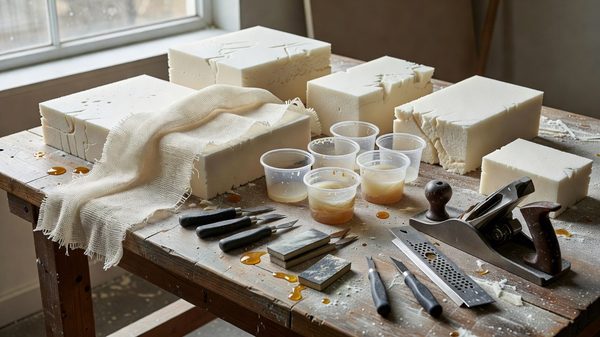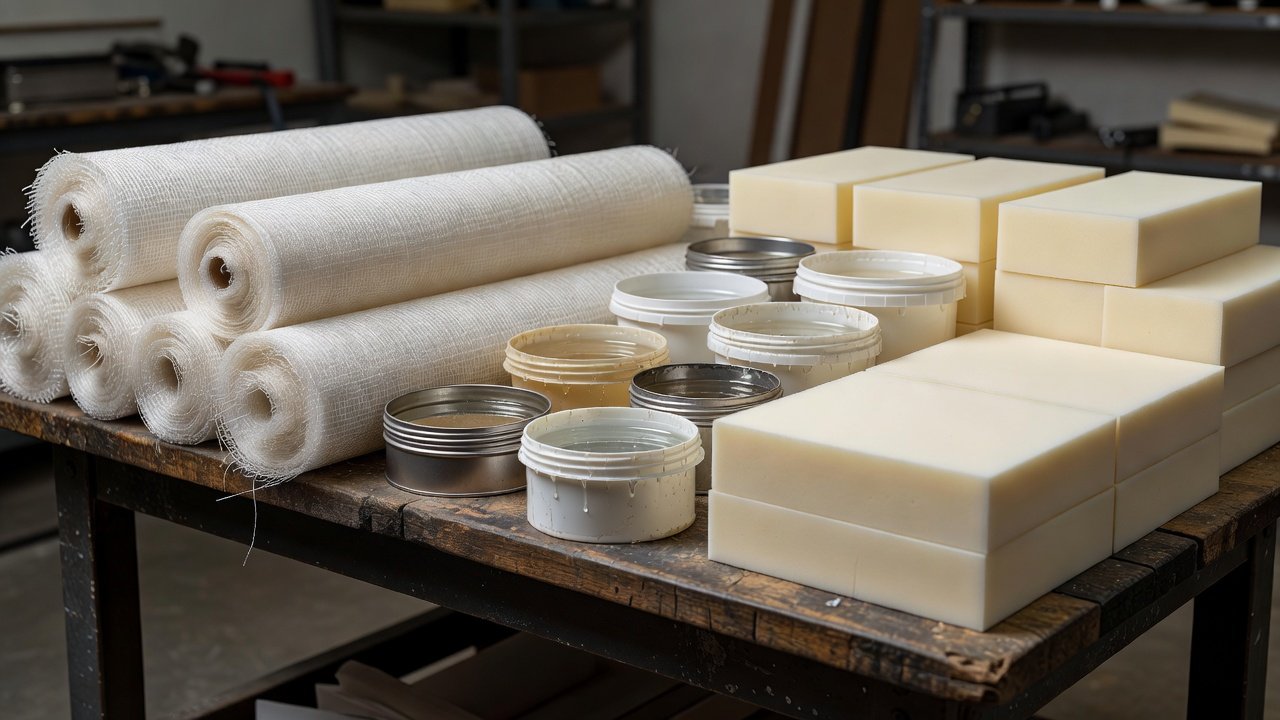
When a prop shell spans two feet or more, the material decision stops being academic. Fiberglass and rigid urethane foam each come with a distinct set of tradeoffs in weight, shop workflow, finishing requirements, and long-term durability. Pick the wrong one for your build conditions and you are either grinding fiberglass for days to get a surface you could have carved in hours, or watching a foam piece dent the first time a convention attendee leans on it.
This guide lays out the decision framework builders use for large shells — the kind that constitute the upper body or dome sections of full-scale robot replicas, oversize helmet props, or freestanding display pieces.
Weight and Structural Logic
Rigid urethane foam wins the weight argument by a wide margin. Cast foam in the 4–6 lb per cubic foot density range delivers enough structural integrity for most prop applications while keeping finished piece weight well below an equivalent fiberglass shell. For a shell that someone has to lift, carry, or wear, this matters enormously — a large fiberglass dome with proper layup thickness can run three to four times heavier than a foam equivalent of the same geometry.
Fiberglass earns its weight through mechanical strength. A properly laminated fiberglass shell resists point impacts, distributes load across the surface, and tolerates flexing without cracking when the laminate schedule includes enough cloth layers and any necessary core material. If your prop needs to survive rough handling — shipping, repeated assembly and disassembly, extended outdoor use — fiberglass at appropriate thickness holds up in ways that foam needs coatings and careful handling to approximate.
The structural hybrid approach, used in professional prop houses for decades, combines both: a rigid foam core shapes the piece quickly, then a fiberglass skin is laminated over the outer surface to harden it. This gives you a piece that is lighter than a solid fiberglass layup, more durable than bare foam, and easier to shape than fiberglass alone. The tradeoff is material cost and additional layup time.
Shop Safety and Working Conditions
This is the factor that builders underweight until they are into a project. Fiberglass lamination with polyester resin means styrene vapors. Styrene is a VOC with real occupational exposure limits; in a home workshop without forced-air ventilation and a proper respirator rated for organic vapors, extended fiberglass sessions are a genuine health concern. Epoxy systems are less volatile than polyester but still require skin and respiratory protection, and some builders develop sensitization with repeated exposure.
Rigid urethane foam casting at the mixing and pour stage involves isocyanate components — also requiring respiratory protection and gloves during the pour. Once cured, the foam itself is inert and safe to handle, sand, and carve with standard dust protection. Total chemical exposure window for a urethane pour is measured in minutes; fiberglass lamination on a large piece can mean hours of continuous resin exposure.
If you are working in a residential garage or basement with limited ventilation, this asymmetry is decisive. The foam wins not because it is chemically benign at every stage, but because the hazardous window is far shorter.
Surface Finishing Comparison
Fiberglass layup produces a surface that is uneven at the cloth weave scale, requires filling with surfacing primer or spot glaze, and then sanding to a paintable finish. With epoxy laminating resin, it typically takes two to three flood coats of resin to fill the weave before final sanding can begin. Gel coat applied over polyester laminate gives you a more finished starting surface, but gel coat application is its own skill set and requires a polyester-compatible resin system throughout.
The end result of well-done fiberglass finishing is a surface that accepts paint beautifully and reads as hard, solid, and professional. Chrome-effect paint over a glasswork smooth fiberglass shell looks the part in ways that require more effort to match on foam.
Rigid foam’s finishing workflow is different rather than harder. The foam surface is soft and accepts primer readily, but it also accepts dents readily. Builders apply a rigid coating — Plasti-Dip, Smooth-On’s PlastiPaste, hard shell coatings, or diluted fiberglass resin brush-applied in thin layers — to stiffen the outer surface before priming and painting. Each coating option has its own hardness, flex, and adhesion characteristics, and getting a mirror-smooth finish on foam takes as much sanding and filling as fiberglass does, just with different products.
The key difference: on foam, you can fix surface errors by adding material back. On a fiberglass layup, adding material means more glass or filler — it is possible but more disruptive to the workflow.
Geometry and Tooling
Fiberglass is a laminate-over-mold process. You need a mold or a plug to lay up against. For complex compound curves — a dome with a specific profile, a torso shell with organic shaping — fiberglass requires significantly more upfront tooling work. The mold must be smooth, properly release-coated, and structurally sound enough to survive the layup process.
Rigid foam can be cast in a simple two-part mold, but more commonly, builders cast a block and carve or machine it to shape. Foam carves readily with hand tools, hot wire cutters, and angle grinders fitted with abrasive discs. For large curved surfaces, this carve-to-shape approach is often faster than building an accurate mold, especially if the geometry is being developed as you go rather than reproduced from an exact pattern.
For reproduction work — where you are making multiples from a proven pattern — fiberglass molding workflow becomes more advantageous. Once the mold is built, pulling additional copies is straightforward. Foam requires carving or casting each piece individually, though casting rigid foam in a mold is entirely practical for moderate quantities.
Making the Decision
For a display piece that stays in one place, has gentle handling, and will be seen rather than touched or transported frequently, rigid urethane foam is the faster path to a finished result with an acceptable durability-to-effort ratio. Build the shape, coat the surface, prime and paint.
For a prop that will ship, travel to conventions, be handled by multiple people, or needs a specific surface quality that reads as mechanically hard from close range, fiberglass delivers durability and surface quality that coated foam approaches but does not fully match.
For large-scale robot body sections where weight is a priority and shop ventilation is limited, the foam-core with fiberglass skin hybrid deserves serious consideration. The structural outer skin keeps the surface hard while the foam core keeps the piece light and shapeable.
Neither material is universally correct. Document your build conditions — shop ventilation, transport requirements, display environment, available tooling, and your own prior experience with each material — and the decision usually becomes clear without requiring any additional data.