When you’re building a large prop shell — a robot torso, a full-scale creature head, a vehicle panel — the material choice made early in the project shapes everything downstream: weight, finishing time, transport durability, and how much specialized equipment you need to pull it off. Fiberglass layup and rigid urethane foam carving are the two paths most prop builders arrive at for shells in the 2–6 foot range. They are not interchangeable and neither is simply better than the other. The right choice depends on your build conditions, your finishing tolerance, and what the prop needs to do once it’s complete.
How Each Method Works
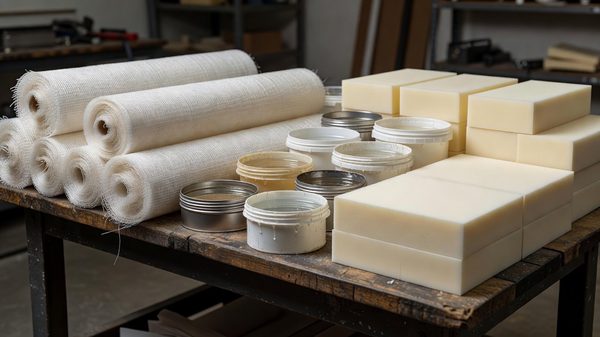
Fiberglass layup starts with a mold (or a positive form) and builds the shell from the outside in. You apply layers of woven fiberglass cloth saturated with resin — either polyester or epoxy — over the mold surface. The laminate cures rigid. Demolded, you have a hollow shell whose exterior surface is a direct mirror of the mold face.
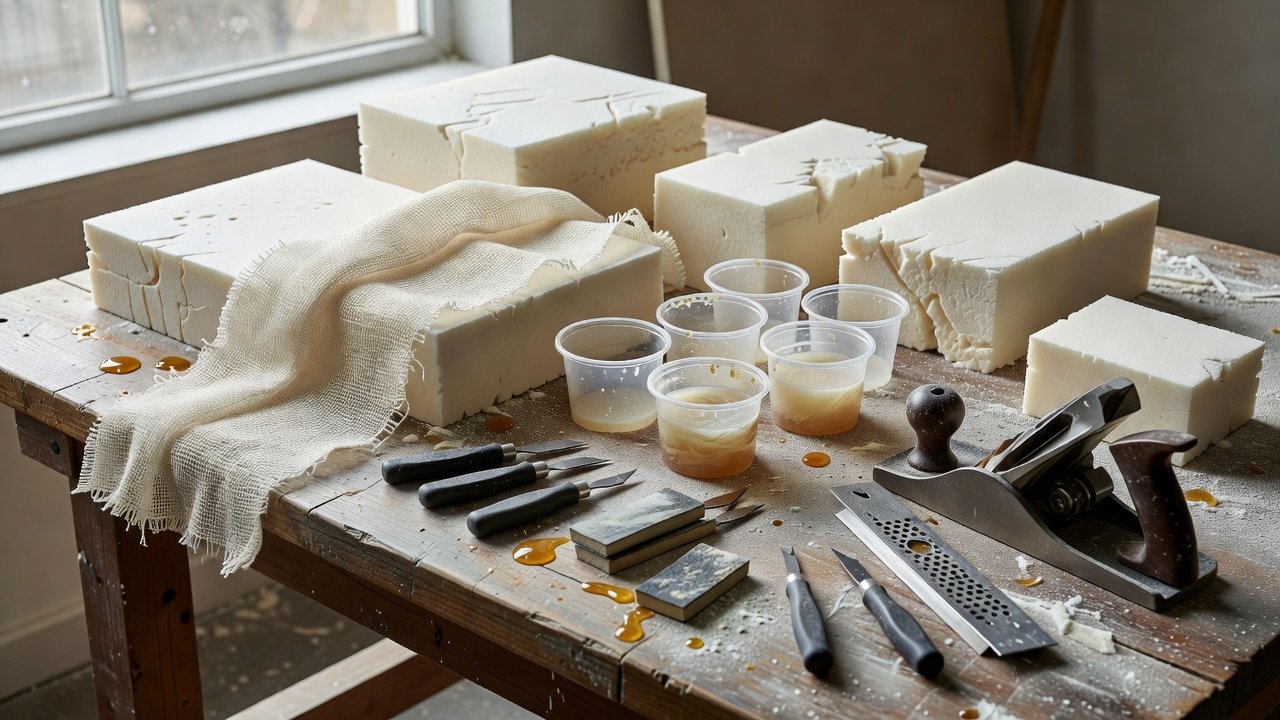
Rigid urethane foam (2–4 lb density modeling foam, sold under names like Foam-iT!, LAST-A-FOAM FR-3706, or generic sign-making foam) is carved from a solid block using rasps, Surform tools, knives, and coarse sandpaper. The exterior is the carved foam surface itself, which then receives a hard-coat treatment before painting.
The starting geometries differ: fiberglass requires a mold or form to exist first; foam carving produces the final shape directly from the block. That difference determines which approach fits your workflow.
Weight
Fiberglass shells run heavier than foam for the same exterior dimensions. A two-layer fiberglass laminate (6 oz cloth, epoxy resin) over a torso-sized mold — say, 18" wide × 24" tall — will weigh in the range of 3–5 lbs depending on how well the layup is controlled and how much resin was used. The Replica Prop Forum community consistently notes that using the right amount of resin — just enough to fully wet the cloth — keeps weight down without sacrificing strength. Excess resin adds weight, not strength; the glass fiber carries the structural load.
Rigid urethane foam at 4 lb/ft³ density is, literally, 4 lbs per cubic foot — but most carved shells are mostly air. A comparable torso shell carved from foam with 3/4" walls will weigh 1–2 lbs. That weight advantage is significant for wearable or puppeteered builds.
Winner for weight: Foam, clearly, for display or wearable applications. Fiberglass for anything where rigidity-to-weight ratio matters more than absolute weight.
Durability and Impact Resistance
Fiberglass shells, when properly laminated with epoxy resin, resist impact and flexing well. Smooth-On notes that epoxy-laminated fiberglass can be hard-coated further with UreCoat flexible urethane coatings to add surface resilience without brittleness. Three layers of 6 oz fiberglass cloth with epoxy produces a shell that can be dropped, loaded into a van, and transported repeatedly without cracking.
Rigid urethane foam is structurally weaker at the surface. Raw carved foam will chip and gouge if knocked against a door frame. The critical step is hard-coating: a shell coat of Smooth-On’s FiberShell, XTC-3D epoxy coating, or a proper two-part polyurea spraycoat from Volatile Free Inc. (VFI) transforms the surface from fragile to genuinely convention-durable. A properly hard-coated foam shell will take the routine abuse of transport and handling without significant damage. What it won’t take is a hard point-load impact — the kind of corner hit that would crack a foam core without a thick enough coating layer.
Winner for durability: Fiberglass for production builds that will see heavy transport use. Foam with proper hard-coat for display and convention builds with normal handling.
Resin Chemistry: The Compatibility Problem You Can’t Ignore
This is the most common mistake in mixed-material builds: polyester resin dissolves polystyrene foam (Styrofoam / EPS). If you try to fiberglass over expanded polystyrene with standard polyester resin, the styrene monomer in the resin eats the foam immediately.
Urethane foam (rigid polyurethane, not polystyrene) is compatible with polyester resin. You can fiberglass directly over rigid urethane foam with either polyester or epoxy resin.
Epoxy resin is compatible with both foam types and is generally preferred for prop work for two reasons: lower fume production during cure, and better adhesion on complex surfaces. The trade-off is cost — epoxy resins run roughly 2–3× the price of polyester per unit volume.
For a hybrid approach — foam carving plus fiberglass skin over the foam — specify rigid urethane foam as the substrate and use epoxy laminate. This produces a lightweight shell with a genuine fiberglass structural skin.
Tooling and Setup Requirements
Fiberglass layup requires:
- Mold or positive form (adds significant labor if one doesn’t already exist)
- Fiberglass cloth (6 oz woven is standard for prop work)
- Epoxy or polyester resin, hardener, mixing cups
- Gloves, respirator, ventilation — polyester resin fumes are significant; epoxy skin sensitization risk requires glove discipline from the first exposure
- Release agent (mold wax or PVA release film)
- Body filler, primer, sandpaper for surface finishing
Rigid urethane foam carving requires:
- Foam block (available from MakerStock and industrial foam suppliers in standard block sizes)
- Rasps, Surform plane, coarse sandpaper (60–80 grit), carving knives
- Hard-coat material (XTC-3D, FiberShell, or polyurea spray)
- Filler primer, sandpaper for finishing
- Dust mask (foam dust is irritating; not as hazardous as fiberglass or resin fumes but still needs respiratory protection)
Foam carving has a much lower setup barrier. There is no mold, no mixing chemistry, and no ventilation requirement beyond dust management. A builder with a foam block, a Surform tool, and a can of XTC-3D can produce a finished painted shell with basic workshop conditions.
Surface Finish Quality
Fiberglass shells molded from a prepared mold surface can achieve a near-perfect finish straight out of the mold — minimal sanding, minimal filler. The mold face defines the part face. This is the primary reason production prop shops use fiberglass for runs of identical parts: the mold investment pays back through consistent, high-quality surface finish on every pull.
Carved foam requires more finishing labor to achieve the same surface quality. Pores in the foam surface fill with hard-coat, but achieving the smooth surface quality of a molded fiberglass shell requires multiple coats of filler primer, block sanding, and patience. The labor investment is higher for foam than for fiberglass pulled from a good mold.
Winner for surface quality: Fiberglass (from a quality mold). Foam requires more finishing rounds to reach the same result.
Which Method to Choose
Choose fiberglass layup when:
- You are pulling multiple identical shells from one mold
- The prop needs to survive heavy transport and rough handling
- You already have a mold from a prior silicone pull
- Weight is secondary to durability
Choose rigid urethane foam carving when:
- You are building one piece with no run planned
- The prop is wearable or puppeteered where weight matters
- Your workspace has basic ventilation, not full spray/lamination setup
- The geometry is irregular enough that building a mold is more labor than carving directly
Consider the hybrid approach (carved foam with fiberglass or hard-coat skin) when:
- You want the weight advantage of foam with improved surface durability
- The shape is complex enough that molding is difficult but rigidity matters
- You are building for convention use where the shell will take handling but not structural load
For B9 torso and collar shells specifically, the builder community has used both approaches successfully. The fiberglass-over-foam hybrid — rigid urethane foam core with a 2-oz fiberglass cloth and epoxy skin — gives a shell that carves like foam, finishes like fiberglass, and weighs considerably less than a full laminate build.
Frequently Asked Questions
Can I use polyester resin over foam to fiberglass a prop shell? Only if the foam is rigid urethane — polyester resin dissolves polystyrene (EPS/Styrofoam) immediately. For safety, use epoxy resin over any foam substrate; it is compatible with all foam types and produces better adhesion.
What density of rigid urethane foam is best for prop carving? 2 lb/ft³ foam carves easily but has a more open cell structure that needs additional filler coats. 4 lb/ft³ is the standard modeling foam density for prop work — it carves cleanly, holds sharp detail, and produces a tighter surface for hard-coating.
How thick should fiberglass layup be for a large prop shell? For a self-supporting prop shell in the torso or head size range, two to three layers of 6 oz fiberglass cloth with epoxy resin is standard. That typically yields a cured thickness of 3–4mm and is strong enough for display and convention handling.
Does hard-coating foam change the dimensions significantly? XTC-3D and similar brush-on hard coats add approximately 1–2mm of thickness per coat, with two coats typical. For most prop shells this is negligible, but for precision replicas with tight clearances (a collar fitting over a torso, for example), account for hard-coat thickness before carving to final dimension.
What is the hybrid foam-plus-fiberglass approach? Carve the shell from rigid urethane foam to near-final shape, then laminate 2 oz fiberglass cloth in epoxy resin over the entire surface. The result is a shell with the lightweight core of foam and the impact resistance of fiberglass skin — significantly more durable than foam alone without the weight of a full fiberglass laminate.