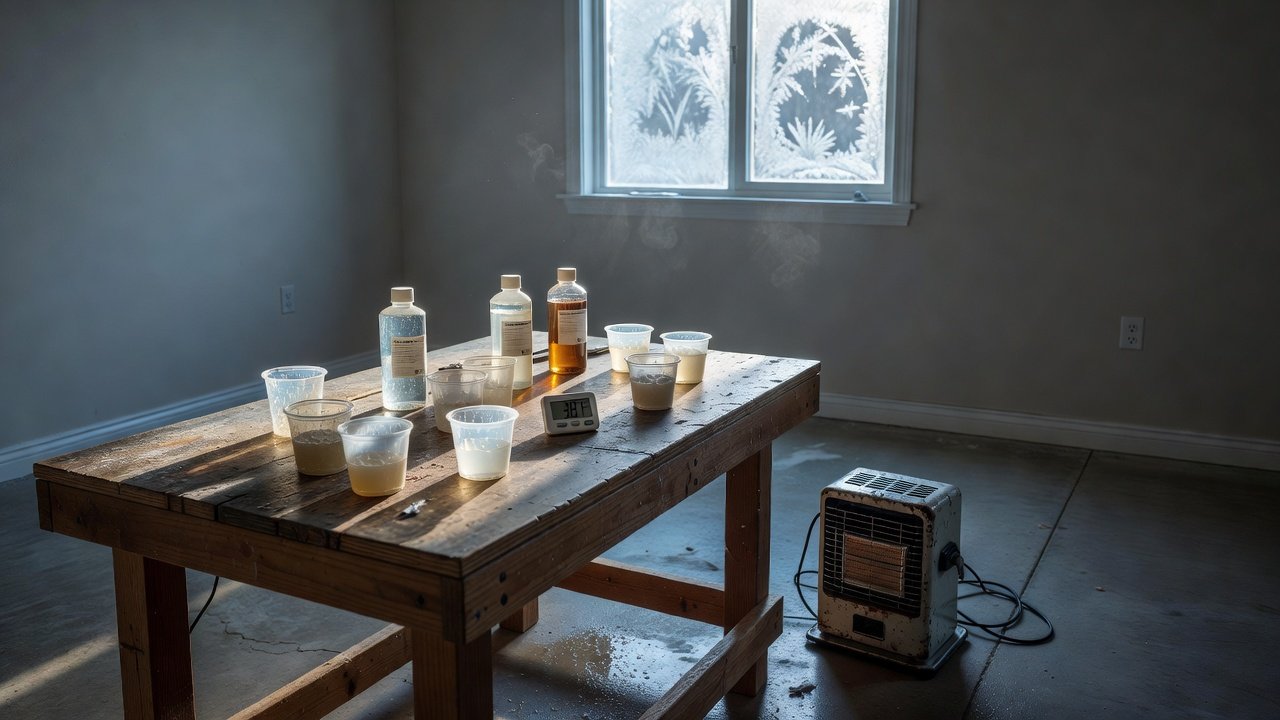
The first cold snap is when a lot of casting projects quietly go wrong. A pour that kicked in minutes in August sits tacky for hours in a November garage, or a mold that should have been ready overnight is still gummy two days later. Nothing about your technique changed. The room did, and every material on your bench is specified for a narrow temperature range.
What the manufacturers actually say
Smooth-On, whose urethane resins and silicones are common in prop shops, is direct about this. Its support FAQ on temperature states that colder conditions increase working time and delay cure for both urethane rubbers and plastics and for platinum silicones. Warmer conditions shorten pot life and cure time. Its guidance for best results is to store and use the materials at room temperature, about 72 to 73 degrees F (23 degrees C).
The product pages repeat that figure. The Smooth-Cast 300 page, for example, says materials should be stored and used in a warm environment at 73 degrees F, and its published pot life of 3 minutes and cure time of 7 to 10 minutes are quoted at that temperature. Those numbers do not carry over to a 50 degree garage. They do not simply double either, because cure chemistry slows in ways the data sheet does not chart.
Tin-cure silicones carry a harder limit. The Mold Max technical bulletin tells users not to cure the rubber where the temperature is below 65 degrees F (18 degrees C), and to let the mold cure at least 16 hours at 73 degrees F before demolding. Smooth-On’s FAQ adds that colder temperatures can delay platinum silicone cure so much that it may not cure at all if applied in an environment that is too cold.
The practical reading: roughly 65 degrees F is the floor for tin-cure silicone, and 70 to 75 is where the published numbers actually apply. If your shop sits below that, the data sheet is no longer describing your pour. This site’s urethane resin beginner’s guide uses the same working range.
Two temperatures matter, not one
Air temperature is the number on the wall thermometer. The number that decides your cure is the temperature of the liquid in the container, the mold, and the master. Smooth-On’s FAQ makes the point that the temperature of the material itself, not just the room, drives behavior in use.
A resin kit that spent a week in an unheated garage is cold all the way through. Bringing the room up to 70 degrees for an hour does not bring a gallon of resin or a block of silicone up with it. Cold liquid is also thicker, so it traps more air and flows into detail less willingly. Warm the material first, then the room.
A winter routine that works
Store materials indoors. The simplest fix costs nothing: keep unopened and partly used containers in a heated part of the house between sessions. Carry them out only when you are ready to pour. This also avoids repeated cold-warm cycles on the containers.
Pre-warm sealed containers. A common practice is to bring both components to room temperature in a warm room for several hours, or in a sealed container set in warm water. Keep lids on and dry the outside of the container before opening. Urethanes are moisture sensitive, and Smooth-On’s product pages note that liquid urethanes absorb atmospheric moisture. A cold container opened in a warm humid room collects condensation, which is exactly the contamination you are trying to avoid. Never heat resin components with an open flame or on a stove.
Warm the mold and the master. A cold silicone mold chills the resin that touches it and can cause thin sections to cure unevenly or trap bubbles. Let the mold come up to room temperature before you pour.
Heat a small zone, not the whole garage. A well-sealed pop-up tent, a spare corner with plastic sheeting, or an insulated cabinet with a thermostat-controlled heater and a thermometer inside gives a stable pocket for curing. Stable matters more than hot: a space that swings from 55 to 80 and back is harder on a pour than a steady 68.
Using heat to speed things up, carefully
Heat is a tool as well as a problem. Smooth-On notes that many mold makers use heat to speed demold time on platinum silicone molds, and that elevated temperatures shorten pot life and cure time. The Smooth-Cast 300 page also describes a post-cure for maximum physical properties: allow the normal room-temperature cure first, then 4 to 6 hours at 150 degrees F (65 degrees C).
Two cautions. First, tin-cure silicones are different. Smooth-On states you cannot heat cure tin-catalyzed silicones in the same way, so do not assume a heat lamp rescues a cold tin-cure pour. Second, adding heat to a large urethane casting shortens pot life and raises the exotherm, so a warm mold and cold-room panic can combine badly in a thick pour. If you move a part to a warm cure area, do it after the resin has gelled, not while it is liquid in the mold.
Heating the shop safely
Resin work and shop heaters have conflicting requirements.
- Avoid open flames and unvented fuel heaters in the work area. Release agents, solvents and some resin systems involve flammable vapors, and unvented combustion heaters add carbon monoxide to an enclosed space. Electric, thermostat-controlled heaters with tip-over protection are the safer fit.
- Do not seal the shop to save heat. Cold-weather casting still needs fresh air; the companion piece on ventilation and respirators for a home resin shop covers how to exhaust fumes without losing all your warmth.
- Keep the heater away from containers and drips. A spill on a hot element is a fire risk.
When to just wait
Some jobs are better postponed. Large, thick-walled castings, thin-section parts that need to fill fine detail, and anything poured into a freshly made tin-cure mold are the least forgiving of temperature. If you cannot hold the pour area at the manufacturer’s stated temperature through the full cure time, a large winter project such as a torso shell or collar section may be better scheduled for a warmer week, with small test pours in the meantime.
Check the technical bulletin for the exact product you are using before the weather turns. If it names a minimum cure temperature, treat that as a firm line, and build your winter setup around holding it for the whole cure, not just for the pour.