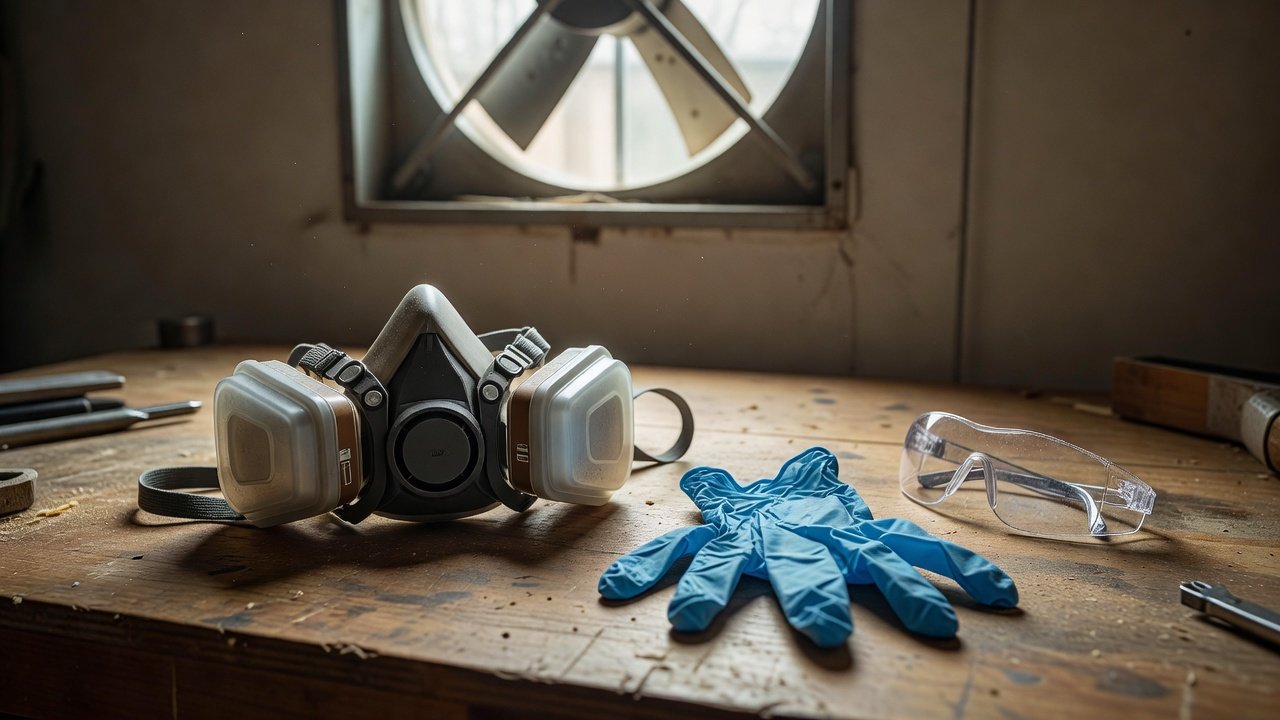
When the garage door stays shut for the winter, fumes that drifted away in July stay in the room with you. That does not make resin casting unsafe, but it changes what counts as adequate protection. This guide summarizes what published safety sources say about ventilation and respirators for common hobby resins, and how to apply it in a home shop. It is general information, not medical advice and not a substitute for the safety data sheet (SDS) for the products on your bench.
Know what is in the container
Start with the SDS for each product, which every manufacturer publishes. The hazard section tells you what you are dealing with, and it varies a lot between product types.
Smooth-On’s SDS for Smooth-Cast 300, a polyurethane casting resin, classifies it as a respiratory sensitizer and skin sensitizer in hazard category 1, with carcinogenicity category 2. Its composition lists MDI-type isocyanates, and the precautions call for use outdoors or in a well-ventilated area, with gloves and eye and face protection. Isocyanates are the reason urethane work needs more than an open window.
OSHA’s isocyanates page describes occupational asthma and other lung problems, along with irritation of eyes, nose, throat and skin, as the main health effects, and notes that some isocyanates are classed as potential human carcinogens. Sensitization is the concern for hobbyists: repeated exposure can make a person reactive to later, smaller exposures. The risk comes from repeated low-level exposure over years, not only one dramatic event. This site’s urethane beginner’s guide makes the same point.
Other hobby chemicals have different hazards. Polyester and fiberglass resins release styrene vapors. Epoxies are skin sensitizers. Aerosol release agents and solvents add flammable, inhalable vapors. Silicone rubber itself is low in vapor hazard, though catalysts and cleaning solvents are not. Read the SDS rather than assuming.
Ventilation first
Respirators are the last line of defense. Published occupational guidance puts engineering controls, meaning ventilation, ahead of personal protective equipment, and in a home shop that starts with moving air.
Exhaust to the outside. A box fan blowing around a closed garage only moves fumes from one corner to another. Use a fan that pulls air out through a window or door, and let fresh air come in through a gap on the opposite side so air crosses the work area.
Put yourself upwind. Position the fan so air flows from you, across the work, and out. If the fan is behind the work and you are in the path of fumes, it is worse than no fan.
Pour near the exhaust. Mix and pour close to the outlet. Fumes released at the far end of the room pass through your breathing zone on the way out.
Keep the fan safe. Flammable solvent vapors can reach an ordinary motor. For work involving solvents or aerosol releases, use a fan rated for the environment or position it so vapors do not pass through the motor, and keep pilot lights and open flames out of the area. The cold-weather casting guide covers heater choices for a winter shop.
Keep others out. Keep children and pets out of the shop while you mix, pour and cure, and leave the exhaust running for as long as the product’s SDS or technical bulletin calls for ventilation.
Winter makes this harder, because exhausting air also exhausts the heat. One workable approach is to ventilate during mixing, pouring and the early cure, then close up once the part has gelled. A smaller heated work zone with a steady exhaust path is easier to manage than trying to warm the whole garage with the door cracked open.
Choosing a respirator
If you use isocyanate-containing resins, vapor-phase and mist protection both matter, and the details of cartridge choice are where people go wrong.
What published guidance names
For isocyanates, occupational guidance commonly names NIOSH-approved air-purifying respirators fitted with an organic vapor cartridge and a P100 particulate filter, or powered air-purifying respirators with the same, with supplied-air respirators as the higher level of protection, particularly when spraying in confined spaces. Published testing on MDI found that organic vapor cartridges without a particulate filter were not effective against MDI aerosols, while organic vapor cartridges combined with a particulate or HEPA-type filter removed more than 99 percent of the aerosol and vapor.
For a home caster, that points to a half-face or full-face elastomeric respirator with replaceable cartridges rated for organic vapors, combined with a P100 filter, either as separate pancake filters or as a combination cartridge. Examples of the designation are the 3M 60921 or North 7581 organic vapor/P100 cartridges. Check the cartridge label and the approval markings rather than the packaging color, since manufacturers vary.
What does not work
- Dust masks and N95s filter particles only. They do not stop vapors.
- Surgical or cloth masks are not respirators.
- Organic vapor cartridges alone leave out the particulate protection published testing found necessary for aerosols. Pour work usually makes little aerosol, but heating, spraying or sanding changes that.
- Particulate filters alone do nothing for vapors.
Fit and seal
A respirator only protects if it seals. Facial hair under the sealing surface leaks. Perform a user seal check every time you put it on, and consider a qualitative or quantitative fit test, which employers are required to provide under OSHA’s respiratory protection standard. Hobbyists are not covered by that standard, but it is a useful benchmark for how seriously to treat fit.
Cartridge life and warning properties
Isocyanates have poor odor warning properties, so you cannot rely on smell to tell you when a cartridge is exhausted. Respirator guidance for contaminants with poor warning properties says there is no secondary way to know when to replace cartridges, and recommends a more conservative change-out schedule, a cartridge with a NIOSH-certified end-of-service-life indicator where one exists for the contaminant, or an air-supplied respirator. For OSHA, an air-purifying respirator is acceptable for diisocyanates only under a full respiratory protection program with an ESLI or a change schedule based on objective data.
Hobbyists do not have industrial hygiene data, so the practical guidance is to replace cartridges on a conservative schedule, store them sealed in an airtight bag between sessions, and replace them when breathing resistance rises or you detect any odor or irritation. Treat any smell during use as a failure, leave the area, and check the seal and the cartridge. Manufacturers publish service-life information; read it for your model.
Particulate filters are separate: replace a P100 filter when it gets hard to breathe through, or when it is damaged or contaminated.
Skin, eyes and the rest
Respiratory protection is only part of the picture. Isocyanates are skin sensitizers according to the SDS, so wear nitrile gloves, change them if they are splashed, and wear eye protection and long sleeves. The beginner’s guide warns against latex gloves if you also work with platinum silicone, since latex can inhibit platinum-cure silicones.
Keep food and drink out of the shop, wash hands before eating, and dispose of mixing cups and cured scraps as the SDS directs.
A winter checklist
- Read the SDS for every product on the bench before the first pour of the season.
- Set up an outbound exhaust path and an inbound air path before you start mixing.
- Use an elastomeric respirator with organic vapor cartridges and P100 filters for isocyanate work, fit-checked every time.
- Keep cartridges sealed between sessions and replace them on a conservative schedule.
- Wear nitrile gloves and eye protection.
- If you notice breathing symptoms such as wheezing, chest tightness or coughing after casting, stop and see a doctor, and tell them which products you work with.
Large replica builds mean long hours near resin, and the habits that protect you over years are boring ones: fresh air, a respirator that fits, and the SDS read before you open the can.